

HACCP is the well-known acronym for the Hazard Analysis and Critical Control
Point system. Writers, conference speakers, and business leaders have frequently discussed it over the last 50 years, but many still misunderstand and apply it poorly in real situations.

HACCP is a logical system of food control based on prevention. In identifying
where the hazards are likely to occur in the process, we have the opportunity to put
in place the measures needed to prevent those hazards from affecting the consumer.
In brief,
Apply HACCP by following a series of straightforward steps:
• Understand your product—what is making it safe?
• Look at your production process from start to finish, understand your operating
environment, and process activities.
• Identify potential hazards and decide where they could occur in the process.
• Put in preventative control measures with defined safety limits.
• Monitor the controls.
• Write it all down and keep records as evidence that you’ve done it.
• Ensure that it continues to work effectively.
The HACCP system considers all types of food safety hazards, including biological, chemical, and physical ones. Effective implementation of a HACCP-based food safety system should, therefore, give the growers, manufacturers, food service
operators, and retailers confidence that the food they provide is safe. This can and
should involve everyone in the company, as each employee has a role to play. This fundamental requirement is often forgotten: the system is not just about documentation, it is also a ‘people system.’ The people who use it own it, maintain it, and keep it current.
What Are the Principles of HACCP?
The HACCP system consists of seven principles which outline how to establish a
HACCP plan for each operation under study. International bodies have endorsed the HACCP principles, and the Codex Alimentarius Commission (1993, 1997, 2003, 2009b) along with the National Advisory Committee on Microbiological Criteria for Foods (NACMCF, 1992, 1997) have published detailed guidance on this approach.
Principle 1. Conduct a hazard analysis. Prepare a list of steps in the process,
identify where significant hazards could occur, and describe the control measures.
Principle 2. Determine the Critical Control Points (CCPs). After describing all significant hazards and control measures, the HACCP team identifies the points that are critical to ensuring product safety—these are the Critical Control Points (CCPs).
Principle 3. Establish Critical limits for control measures associated with each
identified CCP.
Principle 4. Establish a system to monitor control of the CCP.
Principle 5. Establish the corrective actions to be taken when monitoring
indicates that a particular CCP is not under control.
Principle 6. Establish procedures for verification to confirm that the HACCP
system is working correctly.
Principle 7. Establish documentation concerning all procedures and records
appropriate to these principles and their application.
Where did HACCP come from?
The US manned space program originally developed HACCP as a microbiological safety system. It was vital to ensure the safety of food for the astronauts; imagine suffering from foodborne illness in a zero-gravity environment!
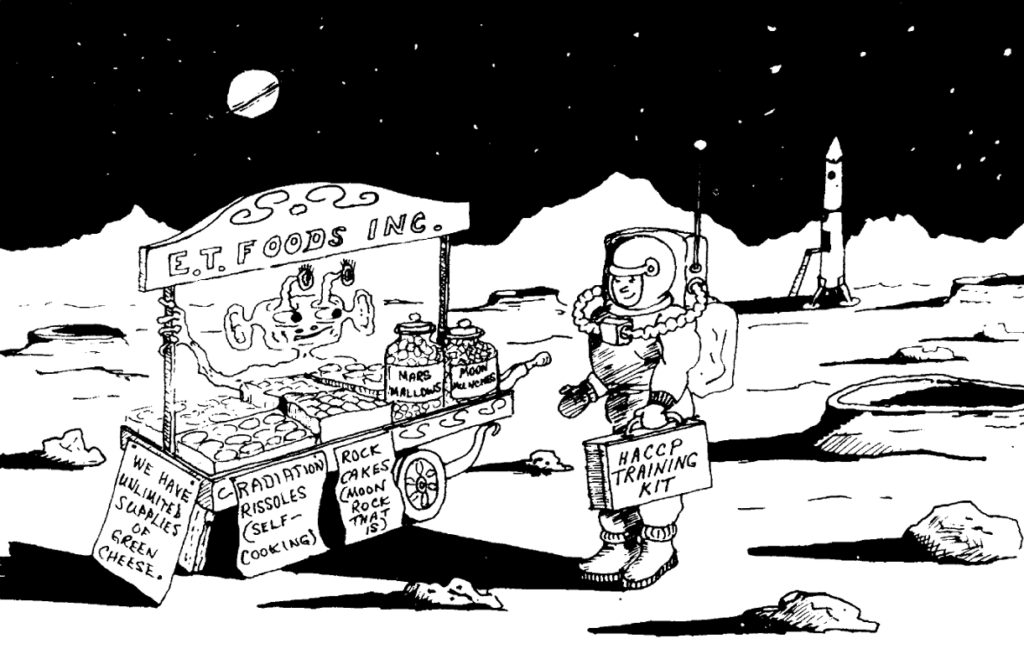
At the time, most food safety and quality systems were based on end-product testing, but safety was assured in this way only if 100% of the product was tested—an impossible approach, since the entire product would have been consumed. Instead, it was recognized that a preventive system was needed to provide a high level of food safety assurance, and thus HACCP was developed. The Pillsbury Company, working alongside NASA and the US Army Laboratories at Natick, pioneered the original system. They based it on Failure Mode and Effect Analysis (FMEA), an engineering method that examines what could go wrong at each stage of an operation, the possible causes, and the likely effects. Effective control mechanisms are then applied to prevent these potential failures from occurring.
Why Should We Use HACCP?
A simple answer is given: ‘because product safety cannot be tested in.’ Therefore, HACCP is recognized as a proven system which, when properly applied, is trusted to ensure that food safety is managed effectively. Moreover, when the system is implemented correctly, product safety is maintained as the highest priority at all times. In addition, opportunities for forward planning are created, allowing potential issues to be prevented before they arise. Consequently, a proactive approach is enabled, rather than a reactive one where problems are addressed only after they have already occurred.
Consumers have a right to expect that each product produced and sold will be safe for
consumption.
Ref: HACCP: A Practical Approach by Sara Mortimore, Carol Wallace

Good article
Good idea
helpful article