

When you use your computer or smartphone, you trust it to work. You don’t consciously think about the millions of lines of code in its operating system (OS) that manage memory, prevent app crashes, and block viruses. You just trust that this complex “system logic” is running in the background, keeping things stable and safe.
Modern food safety works in the same way. The food you buy from a grocery store or restaurant is the end-product of a long, incredibly complex journey. Behind the scenes, a powerful “operating system” is running to manage every step, identify potential “bugs” (hazards), and ensure the final product is safe to consume.
This operating system is built on two core programs: HACCP and its modern upgrade, HARPC. They aren’t just checklists; they are the fundamental logic that powers the entire food safety industry.
The Original OS: HACCP (Hazard Analysis and Critical Control Points)
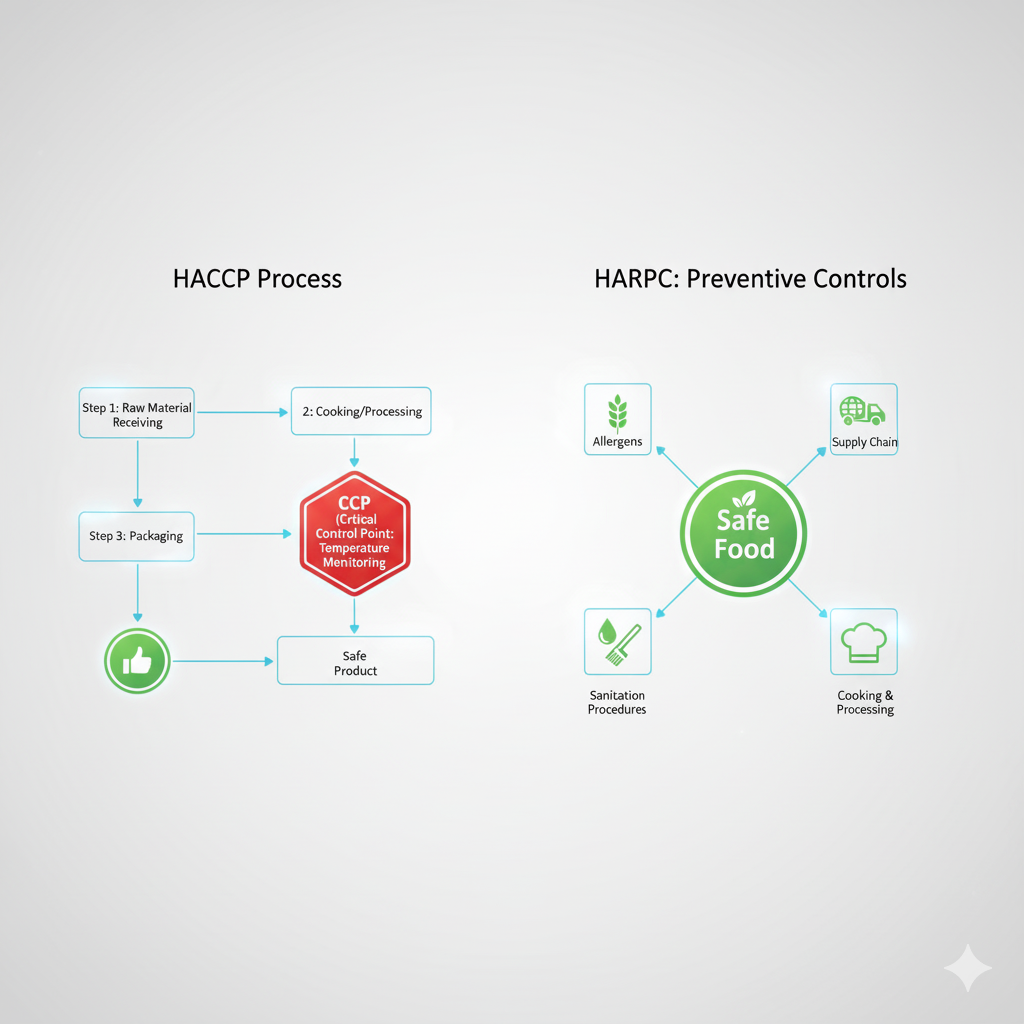
Think of HACCP as the revolutionary “legacy OS”—the system that first brought order to the chaos. Before HACCP, food safety was largely reactive. Factories made food, and then they tested a few samples from the end of the line. If a sample was bad, they’d throw the batch out. It was like trying to find a virus after your computer has already crashed.
Developed in the 1960s for NASA to ensure astronauts’ food was 100% safe, HACCP flipped the script. It’s a proactive system built on a simple, brilliant idea: Instead of finding problems at the end, find the points where problems could happen and stop them before they start.
In this “operating system,” the logic follows 7 core principles, but the main idea is this:
- Analyze Hazards: The program first “scans” the entire process to find any potential “bugs”—biological hazards (like E. coli), chemical hazards (like cleaning fluid), or physical hazards (like a piece of metal).
- Find Critical Control Points (CCPs): This is the key. The system identifies the exact steps in the process where a hazard can be prevented, eliminated, or reduced to a safe level. A CCP is a “do-or-die” moment.
- Run the Program: For each CCP, the system sets strict rules.
- Example: Making pasteurized milk.
- Hazard: Bacteria like Listeria.
- CCP: The pasteurization step (heating the milk).
- Control: The “code” says: “Milk must be heated to 161°F for 15 seconds.” This isn’t a suggestion; it’s a rule in the system.
- Monitor & Correct: The OS constantly monitors these points. If the milk only reaches 159°F, an “error alert” is triggered, and a corrective action (like re-routing the milk to be heated again) runs automatically.
HACCP was a game-changer. It moved food safety from guesswork to a logical, science-based, and preventative system.
The Modern Upgrade: HARPC (Hazard Analysis and Risk-Based Preventive Controls)
If HACCP is the reliable legacy OS, HARPC is the modern, “smart” upgrade. It was introduced as part of the FDA’s Food Safety Modernization Act (FSMA) in 2011.
HARPC takes the core logic of HACCP and expands it. It essentially says, “CCPs are great, but they aren’t the only things that can go wrong.”
The key difference is in the name: Risk-Based Preventive Controls (PCs).
A “Preventive Control” is a broader concept. While a HACCP plan might only focus on the cooking step, a HARPC plan scans the entire environment. It adds new “software modules” to the OS to manage risks that HACCP didn’t traditionally cover.
These new modules include:
- Allergen Controls: Is there a risk of peanuts from one product line accidentally getting into a “peanut-free” product? HARPC manages this.
- Sanitation Controls: Are the cleaning procedures on a cutting board actually effective at preventing cross-contamination? This plan verifies it.
- Supply Chain Controls: The OS now “scans” incoming files. Is the spice supplier you use reputable? Can they prove their ingredients are safe before they even get to your factory?
- Employee Training: Are employees (the “users”) properly trained to follow the safety protocols?
The “Risk-Based” part is also a major upgrade. The system now intelligently analyzes the likelihood of a hazard happening versus the severity if it does. This allows a food facility to focus its resources on the biggest, most realistic threats, making the whole system more efficient and powerful.
An Example: The Chicken Salad Sandwich
Let’s see the two “operating systems” in action.
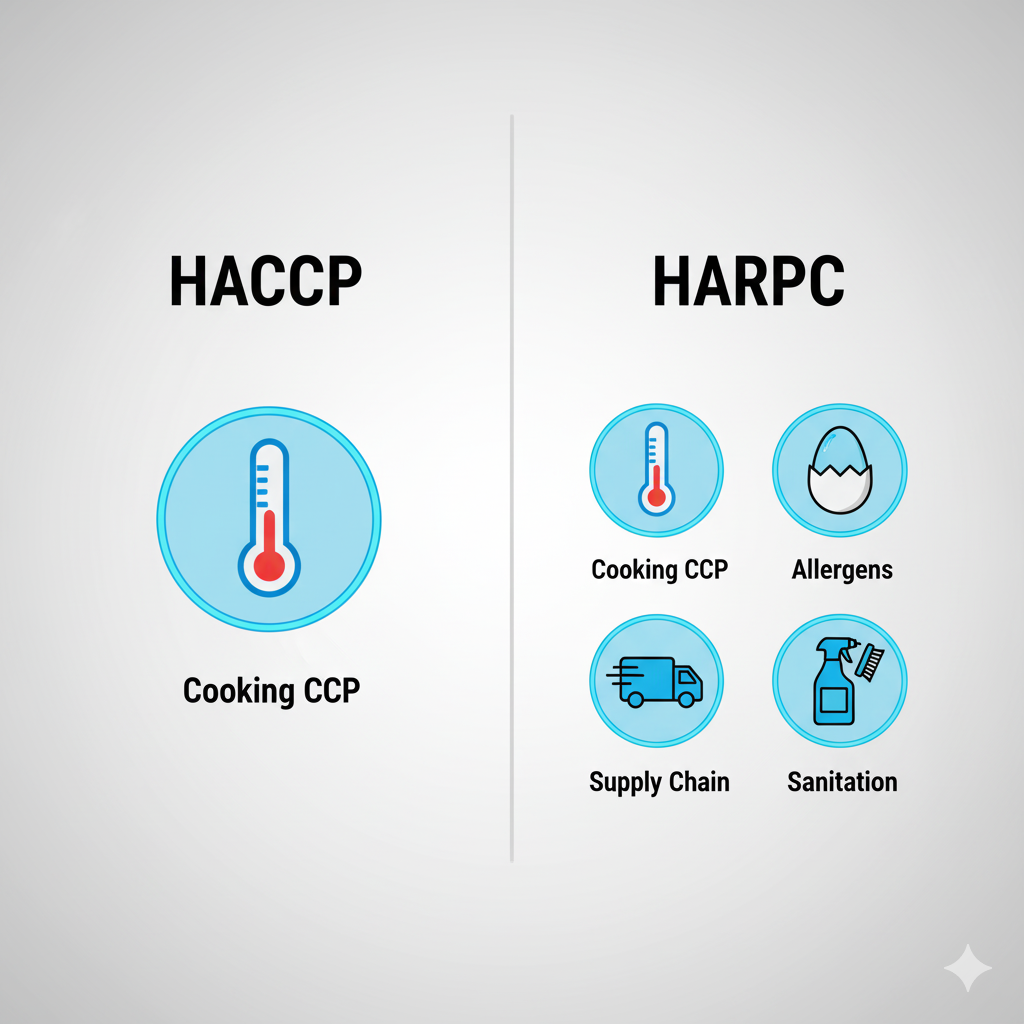
- HACCP’s Logic (The Core Process):
- It identifies the raw chicken as a hazard (Salmonella).
- It designates the cooking step as the CCP.
- It sets a rule: “Cook chicken to 165°F.” It monitors, verifies, and logs this one critical step.
- HARPC’s Logic (The Whole Environment):
- It does everything HACCP does.
- PLUS, it asks:
- (Allergens) “The salad contains eggs (in the mayo) and celery. How do we ensure the ‘Contains: Egg, Celery’ label is correct and that the workstation is cleaned before making a egg-free tuna salad?”
- (Supply Chain) “Where did the mayonnaise come from? Do we trust that supplier’s Listeria prevention program?”
- (Sanitation) “How do we prevent the knife used to dice the raw chicken from
- ever touching the fresh vegetables?”
- (Recall Plan) “If a problem is found later, do we have a system to trace every sandwich and recall them?”
The OS That Keeps You Safe
You don’t need to know the 7 principles of HACCP or the nuances of HARPC to enjoy your food. Just like you don’t need to be a programmer to browse the web.
But the next time you open a carton of milk, eat a bag of lettuce, or order a sandwich, know that a powerful and logical operating system was running in the background. From farm to factory to fork, HACCP and HARPC are the invisible code that makes our modern food supply among the safest in history.
