

Introduction
Keeping fruits fresh, flavorful, and safe to eat is a major challenge in fruit preservation technology.
While traditional methods like canning, drying, and freezing help, modern techniques improve efficiency and quality even further.
Among these innovations, vacuum impregnation (VI) stands out as a particularly powerful method.
Vacuum impregnation leverages the fruit’s natural sponge-like cellular structure. By briefly applying a vacuum, trapped gases escape, and liquid solutions replace them.
These solutions can carry preservatives, nutrients, flavors, or other additives, thereby improving quality, safety, and shelf life.
Consequently, VI is widely applied in minimally processed fruits, as well as in candied and syrup-packed varieties.
Fruit-Fluid Systems in Fruit Processing
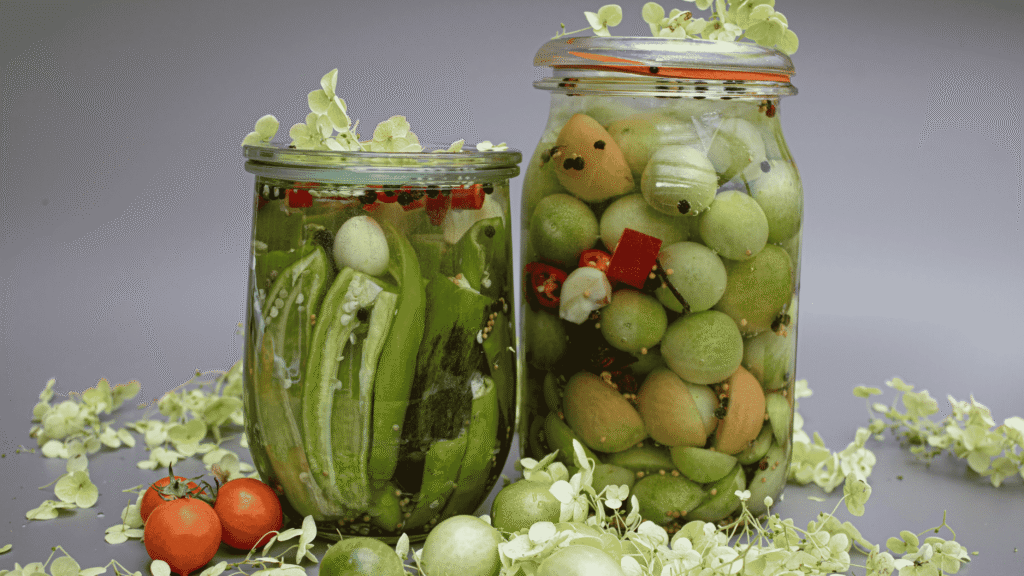
In fruit preservation technology, fruit-fluid systems (FFS) are fundamental because fruits interact with liquids or gases during processing.
For example:
- Fruit-Liquid Systems: Canned fruits, fruits in dairy, osmotic dehydration, rehydration, boiling, candied fruits.
- Fruit-Gas Systems: Air dehydration, chilling, freezing-thawing, modified atmosphere packaging, edible films, and smoking.
Although fruits were traditionally modeled as solid blocks, their cellular structure significantly affects liquid and gas movement.
Therefore, understanding fruit cells allows better control over processing and improved product quality.
Hydrodynamic Mechanism (HDM) in Vacuum Impregnation
Fruits behave like tiny sponges during VI. When immersed in liquid, pressure or temperature changes drive rapid mass transfer. Specifically, trapped gas compresses or expands, while external liquid flows into the pores. This fast transfer is called the hydrodynamic mechanism (HDM).
In VI, applying vacuum pressures of 50–100 mbar removes internal gases. Then, when atmospheric pressure returns, liquid flows in, exchanging gases for solution.
As a result, VI enhances flavor, texture, and shelf life in fruit products.
Applications of Vacuum Impregnation
Moreover, VI can carry functional solutes such as:
- Antimicrobial preservatives
- Anti-browning agents
- Nutrients and flavors
- pH modifiers
- Thermal property enhancers
Compared to simple immersion, VI accelerates absorption and ensures more uniform treatment.
Furthermore, it affects fruit behavior in subsequent processes like osmotic dehydration and candying.
Long-Time Processes in Osmotic Dehydration
After water loss stops, shrunken cells begin relaxing. Consequently, this relaxation drives slow mass transfer over weeks or even months. In osmotic dehydration (OD), cell wall relaxation separates CW-P layers, creating a suction effect. Therefore, external solution enters the cells and intercellular spaces, gradually reducing porosity.
Small temperature or pressure fluctuations further enhance liquid flow. At the same time, gas expansions from these changes leave tissue irreversibly.
In pulsed vacuum osmotic dehydration (PVOD), weight gain mainly results from cell refilling. Cell relaxation increases total volume, and cellular rearrangement expands extracellular space.
CryoSEM images illustrate apple tissue during OD and PVOD at maximum weight recovery. Cell walls regain roundness, and intercellular spaces recover typical shapes. OD samples show nearly full intercellular filling with osmotic solution.
However, highly concentrated solutions reduce structural recovery, while lower concentrations improve it.
Meanwhile, PVOD samples with high concentrations maintain better cell wall roundness and uniform internal recovery.
Advantages of Vacuum Impregnation
Overall, vacuum impregnation allows precise control over fruit properties:
- Flavor: Infuse sweetness, nutrients, or natural flavors.
- Texture: Achieve desired firmness or softness.
- Shelf Life: Protect against microbial spoilage.
- Processing Stability: Prepare fruits for freezing, cooking, or candying.
In addition, VI reduces processing time compared to simple immersion. It also improves product uniformity and minimizes waste.
Consequently, VI enhances overall fruit quality and consumer satisfaction.
Conclusion
In conclusion, vacuum impregnation is a game-changing technique in fruit preservation technology.
By leveraging fruit cellular structure, VI improves flavor, texture, safety, and shelf life.
From minimally processed fresh fruits to candied or syrup-packed products, VI transforms fruit processing.
As consumer demand grows for fresh, safe, and high-quality fruits, vacuum impregnation proves to be a versatile, innovative, and essential solution.
